.png)
AI-Ready or AI-Risky? The 5-Step Data Governance Framework Before You Automate Anything
Here's the uncomfortable truth: most companies racing to automate with AI are building on quicksand.
You're excited about the productivity gains, the cost savings, the competitive edge. But while you're busy deploying chatbots & predictive models, you're ignoring the foundation that determines whether your AI becomes an asset or a ticking time bomb.
That foundation? Data governance.
Skip it, & you're not AI-ready: you're AI-risky. You're one biased model, one compliance violation, or one data quality disaster away from turning your automation dreams into a regulatory nightmare.
Let's fix that. Here's the 5-step framework that determines whether you can safely automate or need to pump the brakes.
Step 1: Assess Your Current State & Define Your Compliance Landscape
Before you automate anything, you need to know where you stand. Most organizations have no clue.
Start by mapping your existing AI systems & data assets. What models are already running? What data feeds them? Who built them? If you can't answer these questions in under 10 minutes, you've got a problem.

Next, understand your regulatory environment. Depending on your industry & geography, you're navigating:
EU AI Act requirements for high-risk AI systems
GDPR mandates for personal data processing
Industry-specific regulations like HIPAA, FINRA, or SOC 2
Internal policies that govern data usage & risk tolerance
Document everything. Your physical data assets, your processes, your pipelines. This isn't busy work: it's your baseline. Without it, you're flying blind.
The outcome: You'll know if you have foundational controls in place or if you're operating in a high-risk, unmanaged state. Most companies discover they're in the latter category. That's okay. Now you know.
Step 2: Inventory Assets & Establish Clear Ownership
Shadow AI is everywhere. Marketing runs its own predictive models. Sales has a custom lead-scoring algorithm. Operations built something in Python that "just works." Nobody documented anything. Nobody owns anything.
This is how disasters happen.
Build a comprehensive inventory of every AI model, system, & data source in your organization. For each asset, define:
Technical metadata: Schema, data types, definitions, version history
Business metadata: Ownership, classification levels, regulatory associations
Access patterns: Who uses it, how often, for what purposes
Dependencies: What breaks if this data source goes down?
Assign clear ownership. Every data asset needs a designated owner & steward who's accountable for quality, compliance, & risk management.
Categorize your data inventory into four buckets:
Owned data: You're confident using this for AI
Public data: Requires assessment before use
Unowned data: Stay away until ownership is clarified
Licensed data: Use with constraints & within terms
The outcome: You eliminate shadow AI & create accountability. When something goes wrong (and it will), you know exactly who's responsible & how to fix it fast.
Step 3: Develop Baseline Policies & Establish Risk Controls
Now that you know what you have, it's time to define the rules of the road.
Your governance policies need to cover:
Data classification: What's sensitive, what's public, what requires special handling
Access controls: Who can access what data & under what conditions
Quality standards: Minimum thresholds for completeness, accuracy, consistency
Retention requirements: How long you keep data & when you delete it
Usage restrictions: What you can & can't do with specific data sets

But policies are worthless without risk controls. Conduct comprehensive risk assessments to identify:
Bias risks: Where could your models perpetuate or amplify discrimination?
Data quality issues: What happens if your training data is incomplete or outdated?
Compliance gaps: Where are you vulnerable to regulatory violations?
Privacy concerns: Are you protecting personal information adequately?
Establish clear workflows for data access requests, quality issue resolution, & governance task management. Make these workflows visible, trackable, & enforceable.
The outcome: You shift from reactive firefighting to proactive risk management. You're no longer wondering if something will go wrong: you're prepared when it does.
Step 4: Automate Enforcement & Embed Governance into Workflows
Here's where most organizations stumble. They build great policies, then rely on manual processes to enforce them. That doesn't scale.
Implement governance tools that enforce policies automatically across your entire data lifecycle: from creation through retirement. This includes:
Automated data quality monitoring: Catch issues before they corrupt your models
Policy compliance checks: Flag violations in real-time, not during audits
Model performance tracking: Detect drift, degradation, or unexpected behavior
Access logging & alerting: Know who's accessing what & when
Set up lineage-driven impact analysis. When data changes, you need to predict how it affects downstream AI applications. If your customer database updates its schema, which models break? Your governance system should tell you immediately.
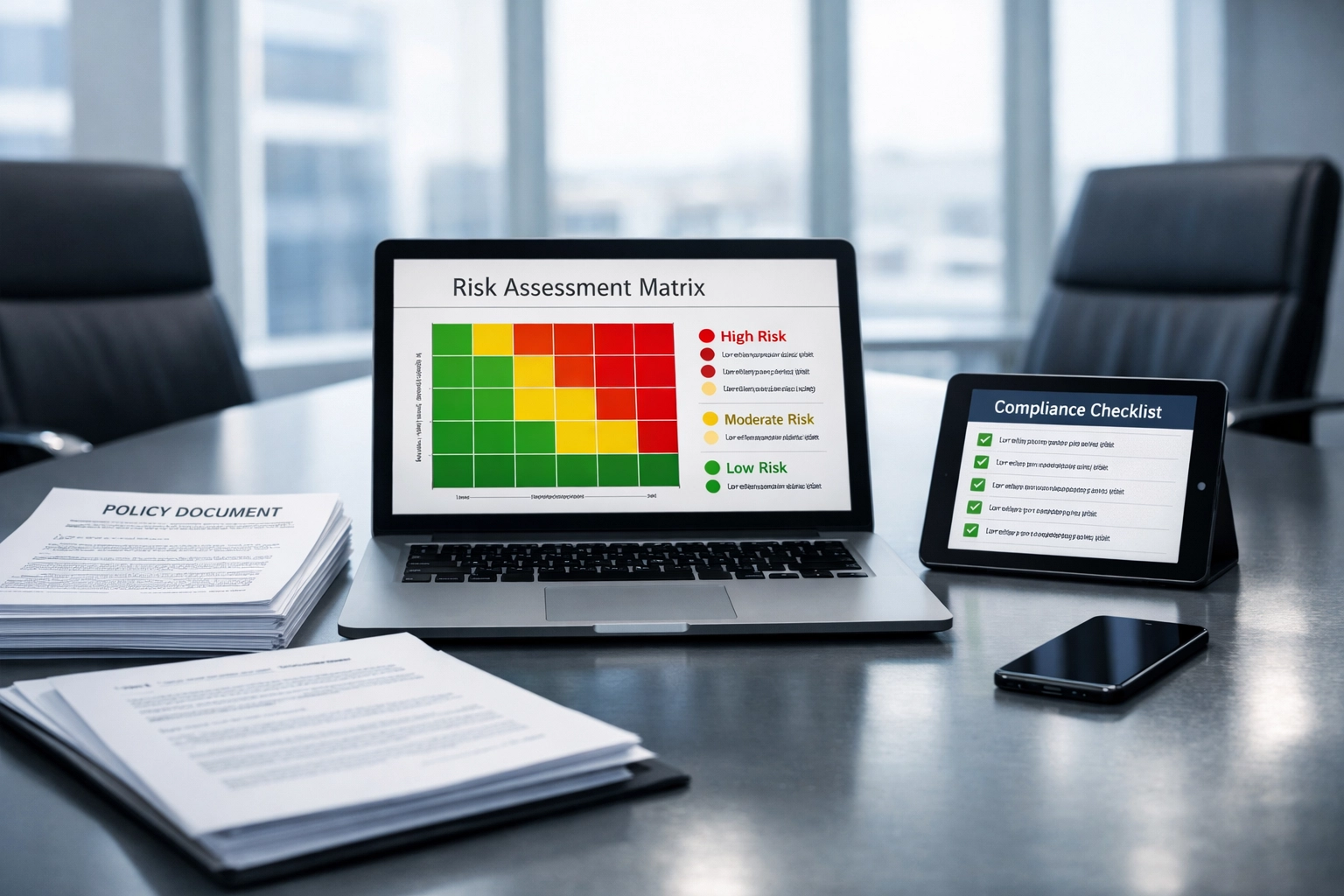
Build governance checkpoints into your development workflows. Before any AI model goes to production, it should pass:
Data quality validation
Bias testing
Compliance review
Performance benchmarking
Security assessment
Make these gates non-negotiable. No exceptions, no shortcuts.
The outcome: Governance becomes invisible infrastructure, not a bottleneck. Your teams can move fast without breaking things because the guardrails are automated.
Step 5: Measure, Improve & Repeat
Governance isn't a one-time project: it's a continuous practice. Your data changes. Regulations evolve. Your AI systems grow more complex. Your framework needs to keep pace.
Establish continuous monitoring & validation processes. Track metrics that matter:
Adoption rates: Are teams actually using the governance tools?
Trust scores: Do stakeholders have confidence in your data quality?
Compliance metrics: How many policy violations are you catching?
Time to resolution: How fast can you fix data quality issues?
Model performance: Are your AI systems delivering expected results?
Conduct regular audits: quarterly at minimum. Review your policies, your risk assessments, your controls. What's working? What's not? Where are the gaps?
Use these insights to iterate & improve. Stay ahead of evolving regulations like the EU AI Act & emerging risks like adversarial attacks or model poisoning.

The outcome: Your governance framework stays relevant & effective. You're not playing catch-up with regulators or scrambling after incidents: you're ahead of the curve.
The Real Cost of Skipping This Framework
Let's talk about what happens when you automate without governance.
Biased models: Your AI recommends lower credit limits for qualified applicants because your training data reflected historical discrimination. Now you're facing lawsuits & regulatory fines.
Data quality failures: Your demand forecasting model makes decisions based on incomplete sales data. You overstock the wrong products, leaving millions in dead inventory.
Regulatory violations: You use personal data for AI training without proper consent documentation. GDPR fines start at €20 million or 4% of global revenue: whichever is higher.
Lack of accountability: Something goes wrong with an AI system. Nobody knows who built it, what data it uses, or how to fix it. Your customers are furious. Your executives are scrambling. Your reputation takes a hit.
This isn't hypothetical. These scenarios play out every quarter across organizations that thought they could shortcut governance.
Are You AI-Ready or AI-Risky?
The difference comes down to one question: Can you confidently answer these five queries right now?
What AI systems are running in your organization & what data powers them?
Who owns each data asset & who's accountable for quality & compliance?
What policies govern your data usage & how are they enforced?
How do you detect & respond to data quality issues or model failures?
How often do you audit & improve your governance framework?
If you're hesitating on any of these, you're AI-risky. The good news? You now have the framework to fix it.
Start with step one. Assess your current state. Be brutally honest about the gaps. Then build forward systematically, one step at a time.
The organizations that get this right don't just avoid disasters: they unlock sustainable competitive advantages. They move faster because they're not constantly firefighting. They innovate confidently because they've built the infrastructure to support responsible automation.
That's the difference between AI-ready & AI-risky. Which one are you building?
If you need help implementing this framework at your organization, reach out to our team. We've helped dozens of companies build governance infrastructure that enables: rather than blocks: AI innovation.
Comments