.png)
Human-in-the-Loop AI: The 4-Step Governance Framework Before You Automate Anything Else
- fflowers32
- Feb 23
- 5 min read
Everyone's racing to automate. Few are asking the right question first: who's watching the machines?
AI can transform your operations, cut costs, and accelerate decision-making. But without proper governance, automation becomes a liability. One faulty prediction, one biased output, one compliance violation, and you're facing lawsuits, reputation damage, or regulatory penalties.
The solution isn't to avoid AI. It's to build human-in-the-loop systems before you scale automation. Here's the four-step governance framework that ensures your AI investments deliver results without blowing up in your face.
Step 1: Define Your AI Organization & Accountability Structure
Before deploying a single algorithm, you need to answer a deceptively simple question: who owns AI decisions in your company?
Most organizations skip this step. They let IT, marketing, or operations deploy AI tools independently. The result? Fragmented governance, duplicated efforts, and zero accountability when something goes wrong.

Build Cross-Functional Ownership
Effective AI governance requires representation across business units:
Business leaders who understand strategic objectives & customer impact
Technical teams who know system capabilities & limitations
Legal counsel who can navigate regulatory requirements
Compliance officers who monitor risk & audit trails
Subject-matter experts who can evaluate domain-specific outputs
Create an AI governance committee with clear decision-making rights. Define who approves new AI projects, who reviews model outputs, and who has authority to shut down systems that underperform or create risk.
Establish Clear Escalation Paths
Document exactly when decisions require human intervention. Low-risk, routine tasks can run autonomously. High-stakes decisions need review protocols.
Define escalation triggers:
Financial threshold breaches
Sensitive customer data handling
Legal or compliance implications
Ambiguous model outputs requiring interpretation
Situations outside training data parameters
Your framework should specify who reviews escalated decisions, response time requirements, and fallback procedures when automated systems can't proceed.
Step 2: Establish Ethical Principles & Human Oversight Rules
Automation without ethics creates operational disasters. Your second step is embedding ethical guardrails directly into AI workflows.
Define Your Non-Negotiables
Start with core principles that apply to every AI application:
Fairness: Systems must treat all customer segments equitably without discriminatory patterns
Accountability: Every automated decision must trace back to a responsible human owner
Transparency: Stakeholders deserve explanations for how AI reaches conclusions
Privacy: Customer data handling must exceed minimum regulatory standards
Safety: Systems must include fail-safes that prevent harmful outcomes
These aren't abstract values. They're operational requirements that shape how you design, deploy, and monitor AI systems.

Map Human Oversight Requirements
Not all AI applications require the same level of human review. Build a tiered oversight model:
High-Risk Applications (mandatory human approval):
Customer credit decisions
Employee performance evaluations
Medical diagnosis or health recommendations
Legal document review
Financial transaction approvals above defined thresholds
Medium-Risk Applications (human review of flagged outputs):
Marketing content generation
Customer service chatbot responses
Inventory forecasting
Sales lead scoring
Operational efficiency recommendations
Low-Risk Applications (automated with periodic audits):
Email categorization
Calendar scheduling
Data entry automation
Simple reporting
Internal process notifications
Document exactly where human subject-matter experts must intervene. Create clear procedures for when model outputs are ambiguous, high-risk, or fall outside normal parameters.
Step 3: Build Action-Level Approval Workflows
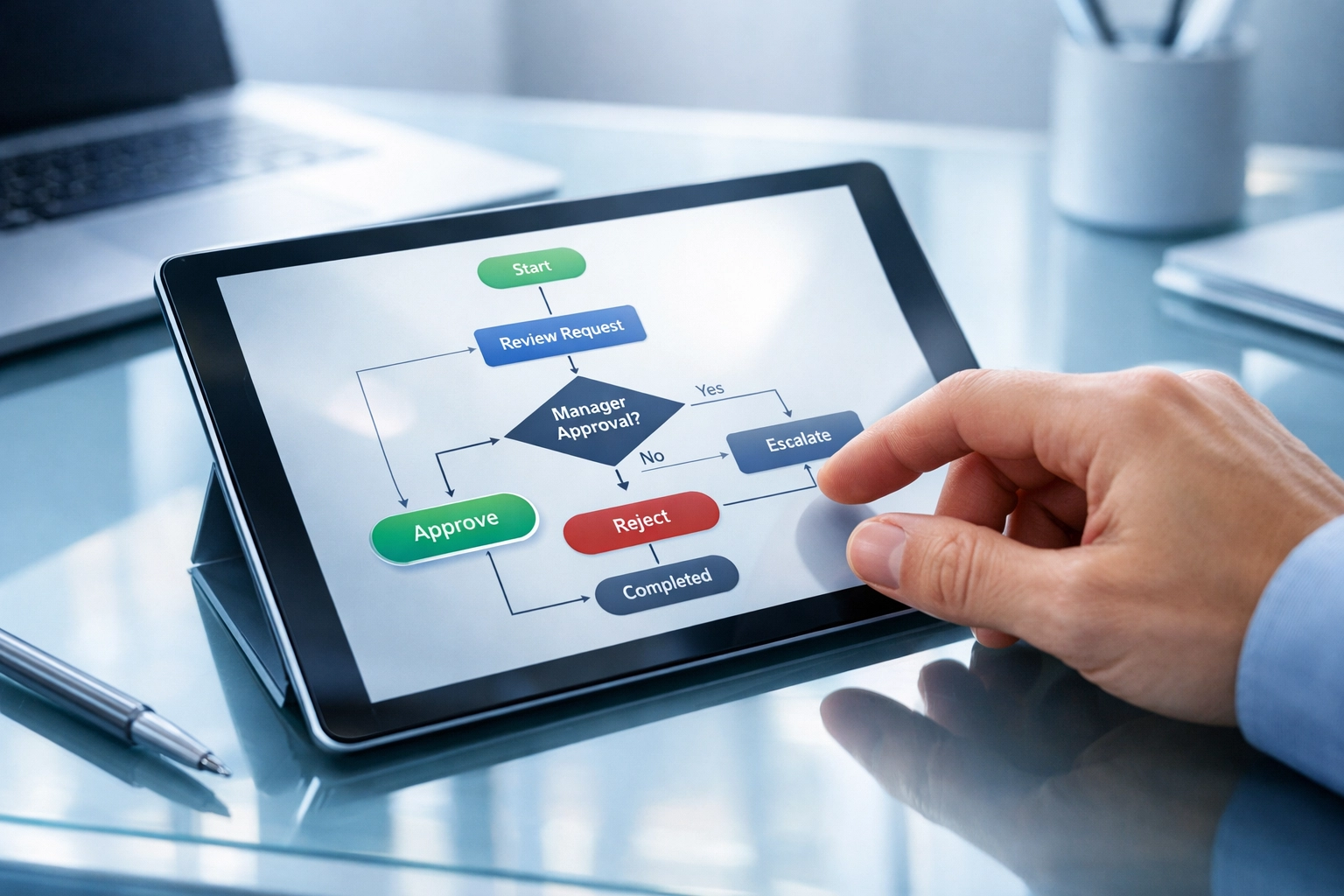
This is where governance becomes operational. Step three embeds human judgment directly into automated workflows through intelligent routing systems.
Design Contextual Review Gates
Not every action needs approval, but sensitive commands should trigger human review before execution. Build workflows that route specific actions based on context:
Financial Actions:
Vendor payments above set thresholds require controller approval
Budget reallocation recommendations need department head sign-off
Pricing changes trigger revenue operations review
Customer-Facing Actions:
Service cancellations route to retention specialists
Negative sentiment responses escalate to human agents
Contract modifications require account manager validation
Compliance-Critical Actions:
Data deletion requests need legal review
Cross-border data transfers require privacy officer approval
Regulatory reporting submissions demand compliance sign-off
Create Complete Audit Trails
Every automated decision and every human override must generate a complete audit trail. Your governance framework needs to capture:
Input data used for automated decisions
Model version and configuration settings
Output recommendations or actions taken
Human reviewer identity and timestamp
Approval or override rationale
Post-decision outcome tracking
These audit trails serve multiple purposes: regulatory compliance, performance improvement, bias detection, and accountability when outcomes are challenged.
Build Smart Fallback Procedures
What happens when your AI system encounters a scenario it can't handle? Define clear fallback procedures:
Automatic routing to qualified human reviewers
Hold queues that prevent action until review is complete
Notification systems that alert appropriate stakeholders
Time-based escalation if initial reviewer doesn't respond
Emergency override protocols for time-sensitive situations
Your fallback procedures are as important as your automation logic. They prevent AI failures from becoming business failures.
Step 4: Implement Audit & Monitoring Mechanisms
Your governance framework isn't a one-time setup. It's a continuous improvement system that requires ongoing monitoring, evaluation, and refinement.
Deploy Real-Time Monitoring
Implement systems that track AI performance continuously:
Prediction accuracy rates across different customer segments
Decision speed and processing efficiency
Override frequency by human reviewers
Error patterns and anomaly detection
Drift in model performance over time
Compliance with defined ethical principles
Real-time monitoring allows you to catch problems before they scale. If your AI starts making biased recommendations, you'll see it in the data and can intervene before it affects thousands of customers.

Conduct Regular Governance Reviews
Schedule quarterly governance reviews that evaluate:
AI system performance against business objectives
Regulatory compliance and audit readiness
Ethical principle adherence across applications
Human oversight effectiveness and bottlenecks
Training needs for review teams
Updates needed for governance policies
These reviews ensure your governance framework evolves as your AI capabilities mature and as regulatory requirements change.
Measure Governance ROI
Track metrics that demonstrate governance value:
Compliance violations prevented
Risk incidents avoided
Customer trust scores and satisfaction rates
Operational efficiency gains from automation
Cost savings from preventing AI failures
Time-to-market for new AI applications
Strong governance doesn't slow down innovation. It accelerates sustainable scaling by building stakeholder confidence and preventing costly mistakes.
The Regulatory Reality
Governance isn't optional anymore. The EU AI Act mandates human oversight for high-risk AI systems, requiring competent personnel with authority to intervene when necessary. Similar regulations are emerging globally.
Organizations that build human-in-the-loop governance now gain competitive advantage. You'll deploy AI faster, scale more confidently, and avoid the compliance scrambles that will paralyze competitors who ignored governance fundamentals.
Start Before You Scale
The best time to implement AI governance was before your first automation project. The second-best time is right now.
Begin with this framework:
Define organizational accountability and decision rights
Establish ethical principles with tiered oversight requirements
Build approval workflows with complete audit trails
Implement continuous monitoring and regular reviews
Organizations that skip governance to move fast end up moving slow when they hit compliance walls, customer backlash, or operational failures. Organizations that build governance foundations scale AI sustainably and capture lasting competitive advantage.
Your AI investments are too valuable to risk on ungoverned automation. Build the human-in-the-loop framework first. Then automate with confidence.
Looking to build an AI governance framework that balances innovation with accountability? Greatstille helps organizations design and implement human-in-the-loop systems that scale. Explore our approach to AI-ready operating systems and performance-driven transformation that deliver measurable results.
Human oversight isn't a bottleneck. It's your competitive moat.
Comments